Museum / 1964–1974
The Hall of Almost
Accession 002 — the AT&T Picturephone
The Picturephone is the strongest near-miss in the collection, because almost nothing about it failed. It was demonstrated in public in 1964 and sold commercially in 1970. It worked. You could see the person you were speaking to, in motion, in real time, thirty years before that was ordinary. AT&T expected a million sets in service by 1980 and sized a decade of manufacturing against the number.
By 1973 there were about four hundred and fifty of them.
Move through the record below. Every card carries how much this museum is willing to stand behind it, and every gap in the chart is a year for which no figure could be verified. The room will not fill those in for you.
1964Sources disagree
A working videophone, in public
AT&T put the Picturephone Mod I in front of the public at its pavilion at the New York World's Fair, and opened booths in New York, Washington and Chicago the same year. You booked a slot, you walked to a booth, and the person you wanted walked to a booth in their city. A three-minute call ran somewhere in the region of $16 to $27 depending on the pair of cities — a week of groceries, to see a face.
What is not settled — The fares differ between accounts, which is why this room gives a range rather than a figure. On Lady Bird Johnson: Plate 1 is a National Archives photograph of her using the service in Washington on 24 June 1964, so that she used it is documented. The separate and much-retold claim that she placed one of the very first calls, in April, is not — the museum has not checked that against a primary record.
1 of 9
The plates
Six photographs, every one of them a real archival image with a traceable source and a checked licence. Nothing here is generated, reconstructed, colourised, or an artist’s impression of a machine nobody photographed.
Each plate says what kind of picture it is before you look at it, because that is the easiest thing in a museum to get wrong. Two were taken in the 1960s. One is period film that somebody scanned much later, from a slide whose photographer is not named. Three are recent photographs of surviving hardware sitting on a museum shelf — those are evidence of what the object looks like now, not of what 1971 looked like. The credit, licence and links for every plate are one click away underneath it.
Plate 1Photographed at the time
24 June 1964
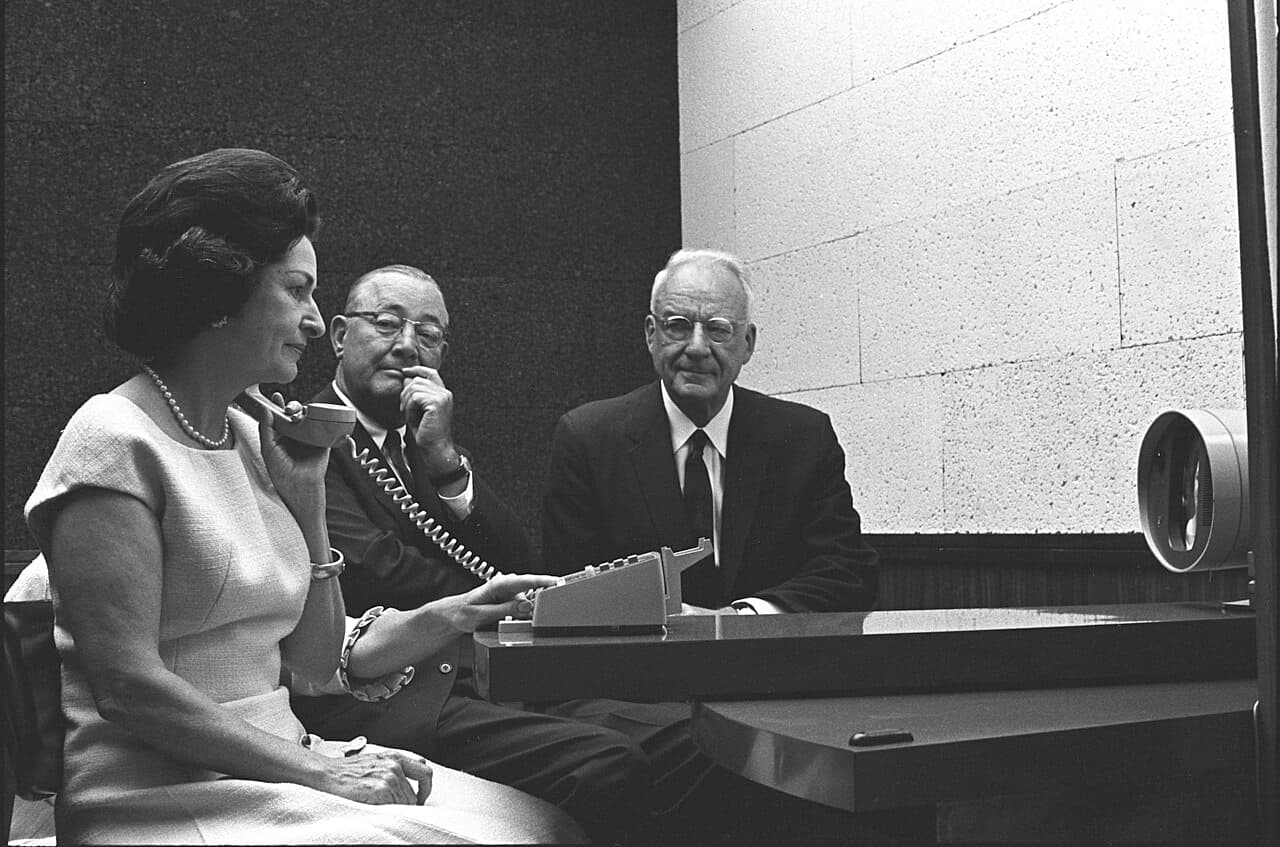
Lady Bird Johnson using Picturephone service at the National Geographic Society building in Washington, D.C. The tapering housing at the right of the frame matches the Mod I in Plate 3; under her right hand is its keypad. This is the closest thing the room has to a picture of the 1964 service being used by somebody who was not demonstrating it for a camera crew.
What is not settled — The archive's caption says only that she is using the service on this date. It does not say this was a first call, and the museum does not present it as one — the widely retold story about an inaugural call in April 1964 is a separate claim and remains unverified here. Identifying the set as a Mod I is the museum's own reading of the shape, not something the archive states. The two men are not named in the record.
Credit, source and licence
- Made by
- White House Photograph Office (Johnson administration)
- Held by
- U.S. National Archives, Lyndon Baines Johnson Library — Johnson White House Photographs, NAID 6801621, local identifier 32721-17
- Licence
- Public domain (work of the U.S. federal government) — no attribution required. Credited anyway.
- This copy from
- Wikimedia Commons file page — the full-resolution original and its complete history.
- Catalogue record
- catalog.archives.gov/id/6801621
Credit this as
White House Photograph Office (Johnson administration). U.S. National Archives, Lyndon Baines Johnson Library — Johnson White House Photographs, NAID 6801621, local identifier 32721-17. Public domain (work of the U.S. federal government).
Plate 2Period film, scanned later
1964 or 1965; the slide was processed in May 1965
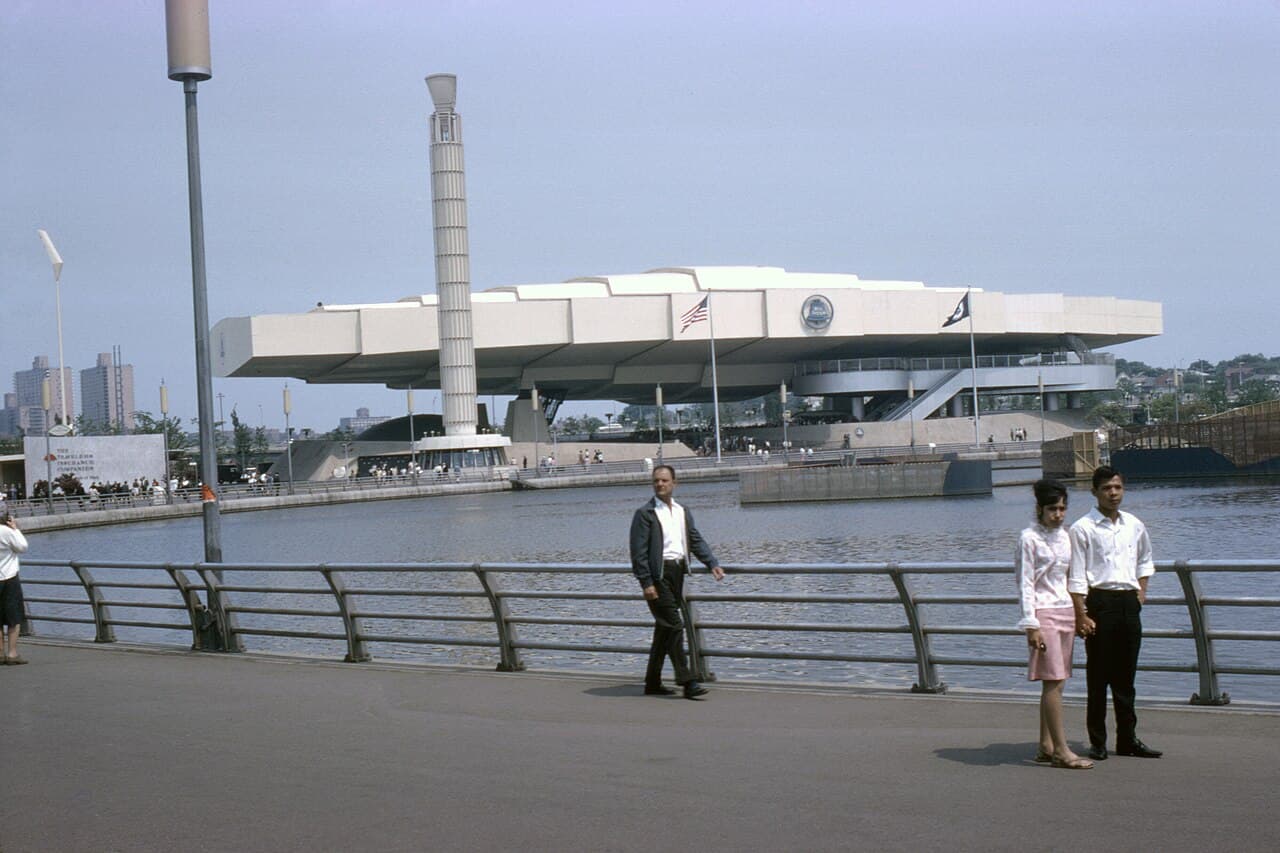
The Bell System Pavilion at the New York World's Fair — the building AT&T demonstrated the Picturephone in. Note what the picture does not contain: the future being sold inside is a small screen a few inches across, and the container built for it is the size of a stadium.
What is not settled — The photographer of the original slide is not identified, and the exposure date is not recorded — only that the film was processed in May 1965, which puts the picture somewhere in the fair's two seasons. The Creative Commons licence covers the scan and its publication; the standing of the original slide is not something this museum can settle. This plate shows the building, not the machine.
Credit, source and licence
- Made by
- Scan and publication by David Pirmann, from the CE Family Collection
- Held by
- Wikimedia Commons, from Flickr
- Licence
- CC BY 2.0 — attribution required, and given below.
- This copy from
- Wikimedia Commons file page — the full-resolution original and its complete history.
Credit this as
Scan and publication by David Pirmann, from the CE Family Collection. Wikimedia Commons, from Flickr. CC BY 2.0 — https://creativecommons.org/licenses/by/2.0/
Plate 3Surviving object, photographed recently
12 July 2026
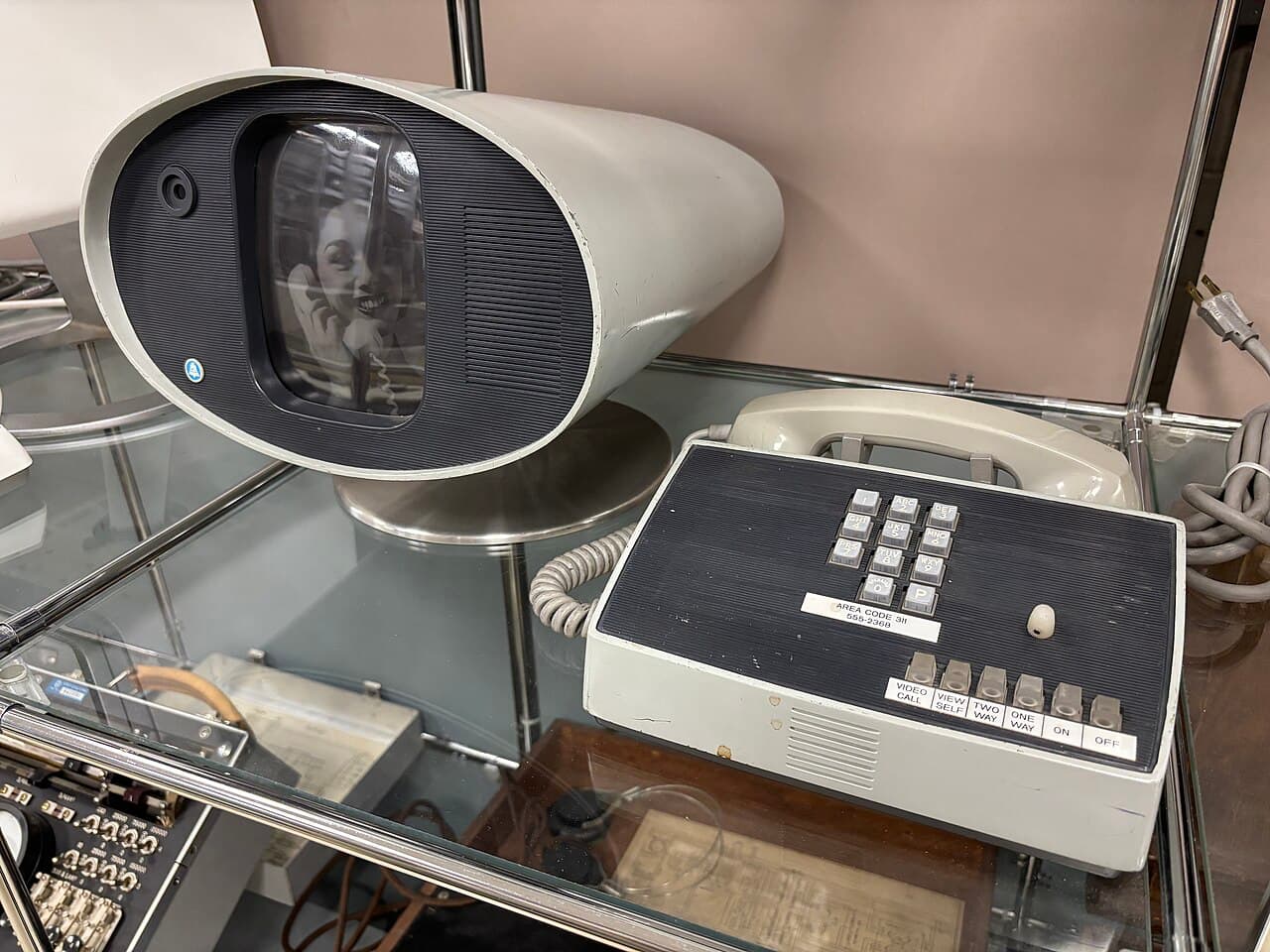
A surviving Mod I — the model behind the 1964 booth service — at the Connections Museum in Seattle. Its control unit is already carrying the argument: VIDEO CALL, VIEW SELF, TWO WAY, ONE WAY, ON, OFF. Somebody in the early 1960s had worked out that you would want to see yourself, and that you would want to be able to say no.
What is not settled — A recent photograph of a museum object, not a picture from the period. The image on the screen is part of the museum's display and is not a live Picturephone call. Reading the button legends off the photograph is the museum's own observation.
Credit, source and licence
- Made by
- Intcreator
- Held by
- Wikimedia Commons; object held by the Connections Museum, Seattle
- Licence
- CC BY-SA 4.0 — attribution required, and given below.
- This copy from
- Wikimedia Commons file page — the full-resolution original and its complete history.
Credit this as
Intcreator. Wikimedia Commons; object held by the Connections Museum, Seattle. CC BY-SA 4.0 — https://creativecommons.org/licenses/by-sa/4.0/
Plate 4Photographed at the time
1970
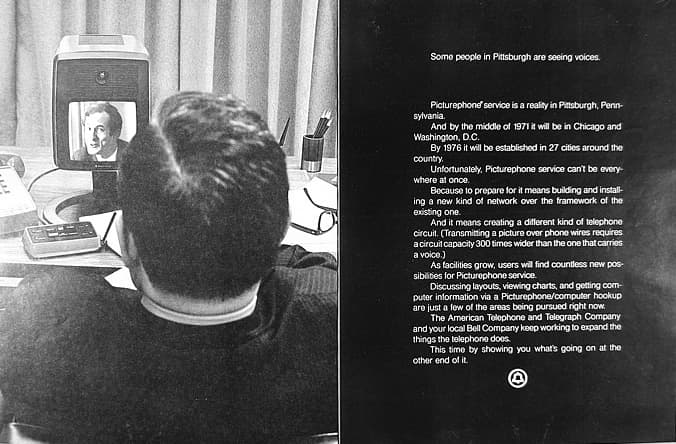
AT&T's advertisement announcing commercial Picturephone service, run in Esquire in 1970. This is the single most useful object in the room, because it is not a memory: it is the company saying, in public and in advance, exactly what it expected to happen. Twenty-seven cities by 1976. Chicago and Washington by the middle of 1971. The claims are read out against the record further down.
What is not settled — Commons records this scan as public domain. The museum has not independently checked that determination, and has not verified the exact issue of Esquire it came from — the year is the granularity the source gives. Everything printed in the copy is advertising written by AT&T in 1970: it is evidence of what the company claimed, not evidence of what was true.
Credit, source and licence
- Made by
- American Telephone and Telegraph Company
- Held by
- Wikimedia Commons — a contributor's scan of the magazine page
- Licence
- Public domain — no attribution required. Credited anyway.
- This copy from
- Wikimedia Commons file page — the full-resolution original and its complete history.
Credit this as
American Telephone and Telegraph Company. Wikimedia Commons — a contributor's scan of the magazine page. Public domain.
Plate 5Surviving object, photographed recently
19 June 2022
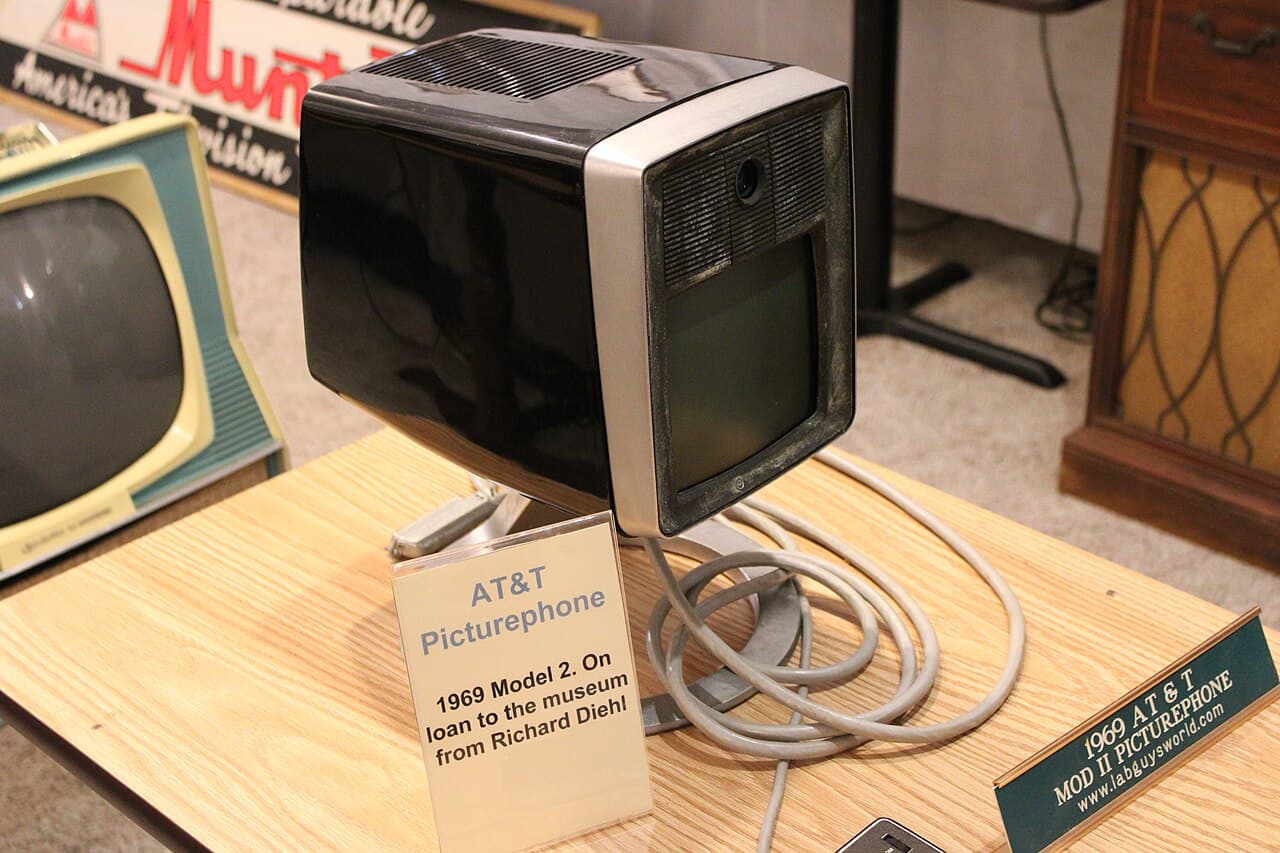
A surviving Mod II — the desk set that was supposed to fix what the booths got wrong — at the Early Television Museum in Ohio. The screen is about five inches across. Every one of those inches wanted roughly a megahertz of bandwidth in each direction, over a country wired end to end for a voice.
What is not settled — A recent photograph, not a period one. The 1969 date and the loan credit to Richard Diehl come from the lending museum's own placard, which is legible in the frame; this museum passes that on rather than confirming it. The screen is dark — nothing is being displayed.
Credit, source and licence
- Made by
- DogsRNice
- Held by
- Wikimedia Commons; object on loan to the Early Television Museum, Hilliard, Ohio
- Licence
- CC BY-SA 4.0 — attribution required, and given below.
- This copy from
- Wikimedia Commons file page — the full-resolution original and its complete history.
Credit this as
DogsRNice. Wikimedia Commons; object on loan to the Early Television Museum, Hilliard, Ohio. CC BY-SA 4.0 — https://creativecommons.org/licenses/by-sa/4.0/
Plate 6Surviving object, photographed recently
19 June 2022
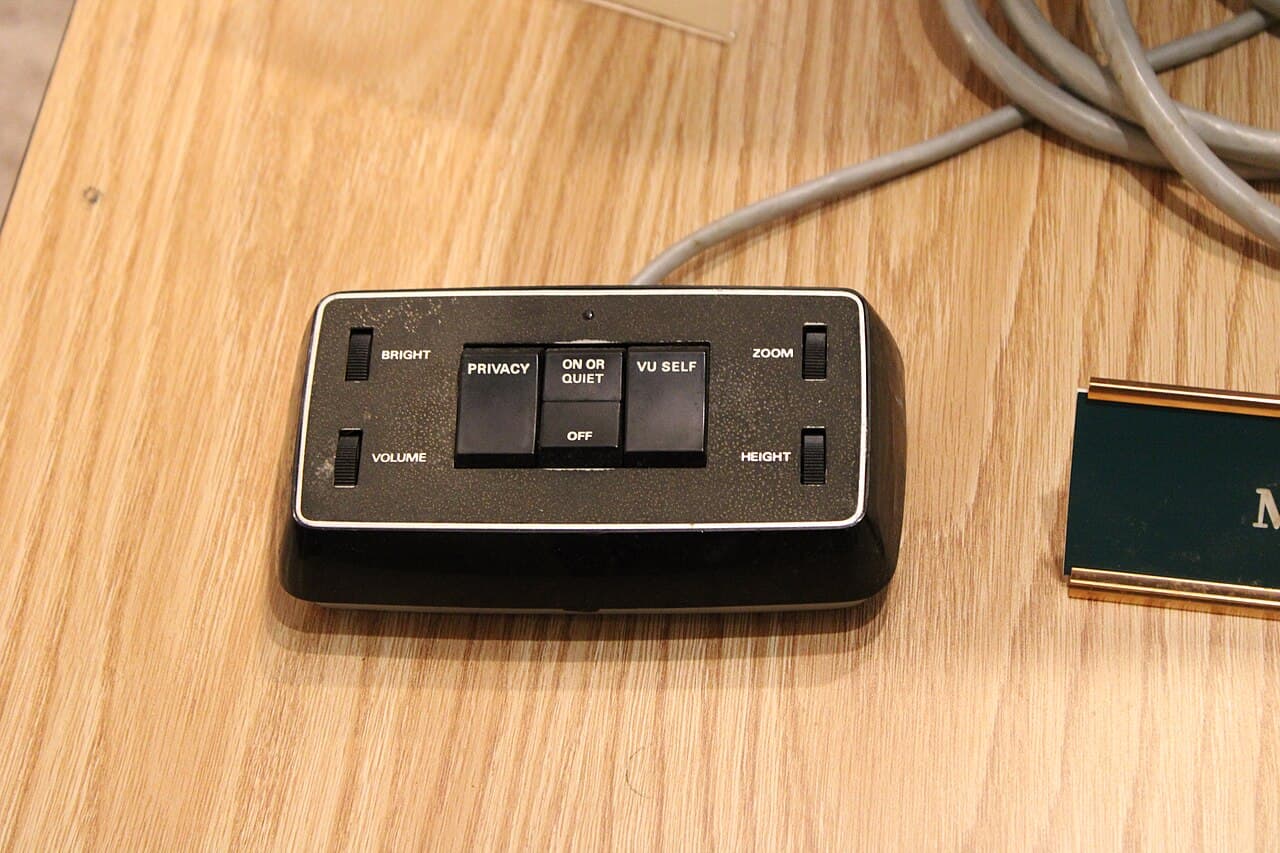
The Mod II control pad. Four sliders — BRIGHT, VOLUME, ZOOM, HEIGHT — and four buttons — PRIVACY, ON OR QUIET, OFF, VU SELF. This is a photograph of a control surface designed before 1971 for a product that sold 453 units, and it is very close to the row of controls at the bottom of a video call today.
What is not settled — A recent photograph of a museum object. The legends are transcribed from the image. The comparison drawn from this plate below is the museum's hindsight and was not a claim anyone made in 1971.
Credit, source and licence
- Made by
- DogsRNice
- Held by
- Wikimedia Commons; object on loan to the Early Television Museum, Hilliard, Ohio
- Licence
- CC BY-SA 4.0 — attribution required, and given below.
- This copy from
- Wikimedia Commons file page — the full-resolution original and its complete history.
Credit this as
DogsRNice. Wikimedia Commons; object on loan to the Early Television Museum, Hilliard, Ohio. CC BY-SA 4.0 — https://creativecommons.org/licenses/by-sa/4.0/
Licences in use across the plates: CC BY 2.0; CC BY-SA 4.0; Public domain; Public domain (work of the U.S. federal government). The copies served here are downsized; each plate’s source link reaches the full-resolution original. Where a licence is share-alike, that condition attaches to the image, not to the surrounding text.
What AT&T said would happen
Most near-futures have to be reconstructed from what people remember expecting. This one does not. Plate 4 is an advertisement AT&T ran in 1970, and it is specific: named cities, named years, a number for the bandwidth. The left column below is the company’s own copy, read off the scanned page. The right column is what the record shows.
The chip on each row grades the museum’s confidence in the outcome, not in the claim. A claim is never graded — it is simply what was said, and it was said whether it came true or not.
“Picturephone service is a reality in Pittsburgh, Pennsylvania.”AT&T, 1970
In the record
True when it was printed. Commercial service opened in Pittsburgh on 30 June 1970, with a reported 38 sets — the smaller of the two counts this room plots.
“And by the middle of 1971 it will be in Chicago and Washington, D.C.”AT&T, 1970
Sources disagree
Service did reach Chicago. The museum could not verify that it arrived by the middle of 1971, and could not establish that Washington ever received commercial service at all.
“By 1976 it will be established in 27 cities around the country.”AT&T, 1970
In the record
It was not. AT&T stopped selling Picturephone during the middle of that decade, with the installed base still in the hundreds. Of every claim on this wall, this is the one that missed by the most and the one stated most precisely.
“Transmitting a picture over phone wires requires a circuit capacity 300 times wider than the one that carries a voice.”AT&T, 1970
In the record
AT&T naming the problem itself, in its own advertising, in the same column as the promise of 27 cities. The February 1971 Bell System Technical Journal put the requirement on the order of a megahertz in each direction.
Why it did not arrive
Two reasons, and neither is a failure of engineering. The first is bandwidth: a Picturephone channel wanted on the order of a megahertz in each direction, against a national network built end to end for a voice circuit. Every subscriber meant new wire, new switching, new transmission — the network could not be upgraded one customer at a time, and the price tag reflected it. AT&T knew this and printed it in its own advertising, at three hundred times a voice circuit.
The second is the one that actually killed it. A videophone is worth what the population of other videophones makes it worth. At a few hundred sets nationally, nearly every call a subscriber wanted to place was to somebody who did not have one, so $160 a month bought a device for talking to a handful of colleagues. There was no price at which that was a good deal, and no advertising that could fix it. The product needed to already be common in order to become common.
What survived
The future itself was not wrong. Video calling arrived on roughly the terms AT&T predicted — it just arrived over a network somebody else had already paid to build, on hardware people had bought for other reasons, at a marginal price of nothing. The part AT&T got wrong was never the demand. It was who would have to fund the wire.
Something smaller survived too, and it is sitting in Plate 6. The Mod II control pad had four sliders and four buttons, and a visitor who has ever joined a video call will recognise almost all of them.
- PRIVACY
- the camera-off button
- VU SELF / VIEW SELF
- the self-view thumbnail in the corner
- ON OR QUIET
- mute
- ZOOM / HEIGHT
- framing your own head in the shot before you join
- TWO WAY / ONE WAY
- audio-only, camera off, and everyone knowing which you picked
This comparison is the museum’s, drawn in hindsight, and it is not a claim anybody made at the time. Nobody at Bell Laboratories was designing for a 2020s video call. They were solving the same problem with the same constraint — a camera pointed at a person who would rather sometimes not be seen — and they arrived at the same short list of controls. The left-hand column is transcribed from photographs of two surviving control units; the right-hand column is a present-day reading of them.
What this room does not know
- The call counts from the 1964–68 booth years. They are quoted confidently in many places and this museum could not trace them to a source it could check, so they are not here.
- Year-by-year installed base. Two counts are plotted. Everything between them is a straight face and an empty stretch of chart.
- The exact booth fares, the exact withdrawal dates, and what the ~$500 million development figure actually counts. All three vary between accounts.
- Whether Lady Bird Johnson placed one of the first calls in 1964. Plate 1 settles less of this than it looks like it does: the National Archives record shows her using the service in Washington on 24 June 1964, two months after the fair opened. That she used it is now documented. That she was among the first to, or that she placed an inaugural call in April, is still only a widely retold story.
- Whether Picturephone service ever reached Washington, D.C. commercially, and whether Chicago met the mid-1971 date AT&T advertised. Both are claims from Plate 4 that the museum could not follow up.
Sources
The room summarises these rather than quoting them. The one exception is the 1970 advertisement in Plate 4, which is quoted directly and at length — it is a public-domain document and the exhibit turns on what it actually says. Where sources disagree — on the fares and on the counts, they do — the disagreement is shown rather than averaged.
The Picturephone System (special issue)
Bell System Technical Journal, Vol. 50, No. 2, February 1971
The Mod II set as built: bandwidth, picture, switching and transmission. The primary engineering description.
Picturephone issue
Bell Laboratories Record, 1969
The programme as AT&T described it publicly, including the scale it expected.
A. Michael Noll, “Anatomy of a Failure: Picturephone Revisited”
Telecommunications Policy, Vol. 16, No. 4, May/June 1992, pp. 307–316
The post-mortem by a former Bell Labs researcher. Origin of the 453-sets figure this room plots.
Engineering and Operations in the Bell System, 2nd edition
AT&T Bell Laboratories, 1983
The Bell System's own retrospective account of the programme and its withdrawal.
Photographic sources are listed on each plate rather than here, because a picture’s provenance belongs next to the picture.